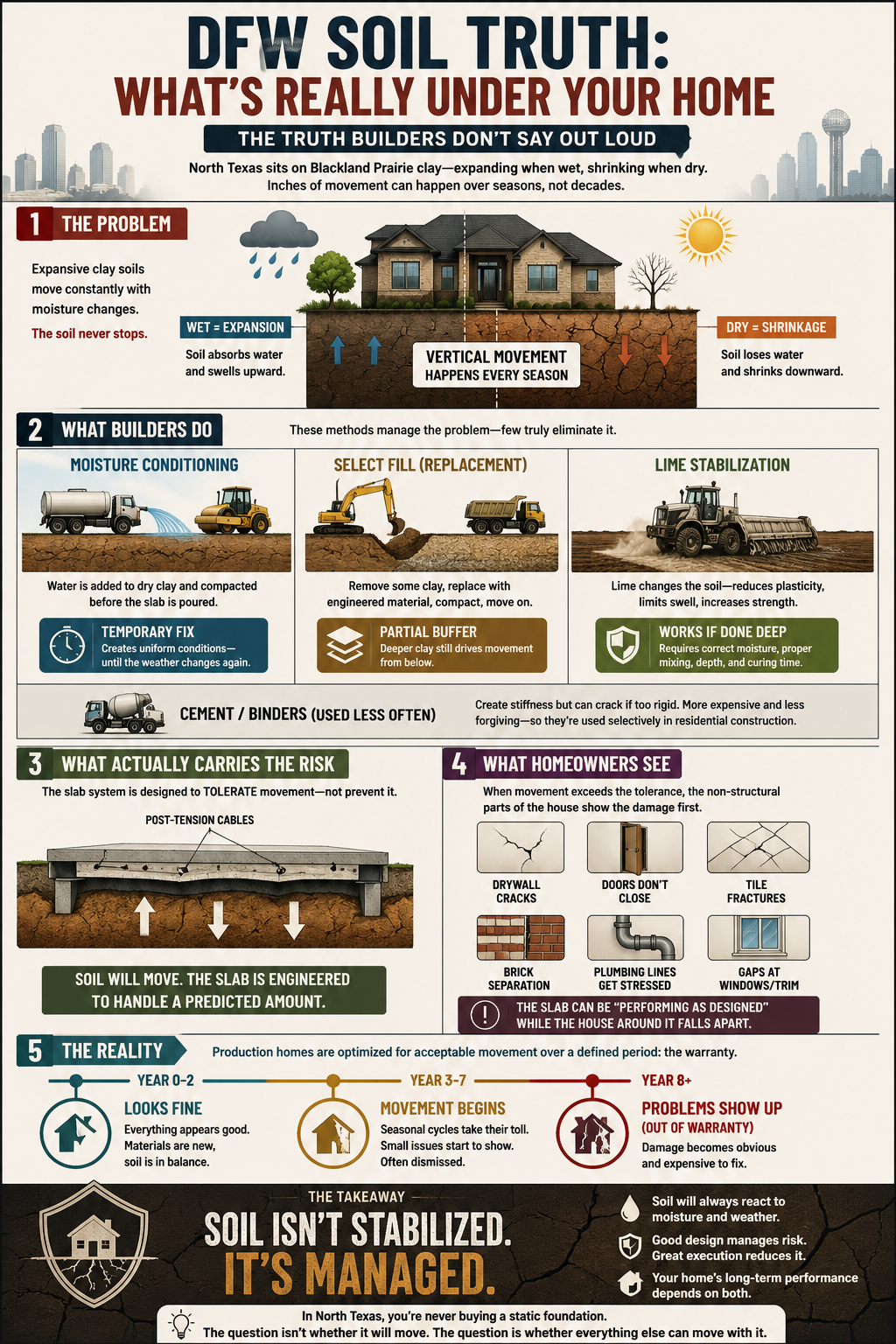
North Texas is built on dirt that wants to destroy houses. That is not an exaggeration. The Blackland Prairie clays under DFW expand when wet, shrink when dry, and do it relentlessly. Inches of vertical movement are not unusual. Not over decades—over seasons.
And yet, entire subdivisions go up as fast as crews can pour slabs.
So the real question isn’t what methods are used. The real question is this: how much of the problem is actually being solved, and how much is just being managed long enough to get past a warranty clock.
Because in production homebuilding, soil is not stabilized. It is negotiated with.
Most buyers assume something has been done to make the ground stable. Engineers assume their recommendations will be followed. Builders assume movement will stay within tolerance. Everyone is making assumptions. The soil is not.
Start with the most common move: moisture conditioning. Water gets added to dry clay, it gets compacted, and a slab goes on top. On paper, this creates uniform conditions. In reality, it creates a moment in time. The second weather cycles take over again, the soil goes right back to doing what it has always done. This is not stabilization. It is a temporary alignment of variables so construction can proceed.
Then there is select fill. Dig out some of the clay, bring in engineered material, compact it, move on. This works—up to a point. The problem is that the clay doesn’t stop where the excavation ends. If you remove two feet of active soil sitting on top of ten feet of highly reactive material, the system is still being driven by what’s underneath. In production environments, depth gets value-engineered. Every additional inch costs money. So what you get is not full isolation from expansive soil behavior. You get partial buffering.
Lime stabilization is where things start to look like actual engineering instead of damage control. When done correctly, lime changes the soil itself. It reduces plasticity, limits swell potential, and increases strength. This can work extremely well. Decades well. The catch is that it has to be done right—correct moisture, proper mixing, adequate depth, and time to cure. That last part alone conflicts with production schedules. And depth matters more than most people realize. Treat the top foot and you’ve improved the surface. Treat several feet and you’ve changed the system. Most production work lands somewhere in between, which means performance lands there too.
Cement and other binders show up less often in residential work, not because they don’t work, but because they are less forgiving and often more expensive. They create stiffness. Strength is not the problem in expansive soils—movement is. A system that is too rigid can crack rather than accommodate. So builders tend to default to methods that are cheaper and more tolerant of imperfect execution.
And then there is the part nobody markets as soil stabilization but is actually doing most of the work: the slab itself. Post-tension slabs, grade beams, reinforcement layouts—this is where the real strategy lives. Not stopping the soil from moving, but designing a structure that can survive it. The entire approach shifts from prevention to tolerance.
That sounds reasonable until you understand what “tolerance” actually means. It means the slab is designed around an expected amount of movement. Not zero. Not minimal. Expected. Engineers calculate how much differential movement the structure can absorb before it becomes a problem. That becomes the design target. If the soil behaves within that range, the house performs. If it doesn’t, everything that isn’t the structural slab starts to fail first.
And that is exactly what happens.
Drywall cracks. Brick separates. Tile fractures. Doors don’t close. Plumbing lines get stressed. None of these are considered structural failures, which is convenient, because they are the things homeowners actually see. The slab can technically be performing “as designed” while the house around it slowly tears itself out of alignment.
This is not a defect in the system. This is the system working exactly as intended.
Because production building is not optimized for zero movement. It is optimized for acceptable movement over a defined period of time. That period of time has a number attached to it: the warranty.
Once you see that clearly, everything else makes more sense. Soil reports are interpreted through cost. Stabilization depth is negotiated. Construction speed compresses curing times. Drainage is designed to meet minimum requirements, not eliminate risk. And homeowners inherit a structure that is fundamentally dependent on consistent moisture conditions in an environment that is anything but consistent.
Over time, the hierarchy becomes obvious. Deep treatment—whether through lime or full replacement—performs the best because it actually changes the system. Shallow treatment improves conditions but leaves deeper drivers untouched. Minimal preparation does almost nothing long term. But minimal preparation is fast, cheap, and usually good enough to get through inspections and early occupancy.
That is the uncomfortable reality. Most production homes in DFW are not sitting on stabilized soil in the way people think. They are sitting on managed risk, backed by structural design that assumes a certain level of ground movement and hopes reality stays within that envelope.
Sometimes it does. Sometimes it doesn’t.
The soil does not care either way.
If there is a single takeaway, it is this: in North Texas, you are never buying a static foundation. You are buying a system that is constantly reacting to moisture, weather, and site conditions. The question is not whether it will move. The question is whether everything built on top of it was designed, constructed, and maintained well enough to move with it without coming apart.
Most of the time, that answer depends less on the method that was chosen and more on how seriously the risk was taken when nobody was looking.
Planned Obsolescence—Whether Anyone Admits It or Not
No one in production homebuilding will stand up and say they are designing houses to fail. That is not how it is framed internally, and it is not how engineers write reports. But when you strip away the language and look at the incentives, the outcome starts to look uncomfortably close to planned obsolescence.
Not in the sense that a house is meant to collapse. That would be illegal and obvious. But in the sense that it is designed to perform adequately within a defined window, after which the risk shifts quietly onto the homeowner.
Everything in the system points in that direction. Soil treatment is often minimized to what is required to support the slab design assumptions. Slabs are engineered around expected movement ranges, not worst-case conditions. Drainage is built to pass inspection, not to eliminate long-term variability. Landscaping gets installed that will eventually alter moisture profiles. Irrigation systems introduce inconsistency. Trees get planted within influence zones that were never accounted for in the original design.
None of these decisions individually guarantee failure. Together, they create a system that is highly sensitive to time.
For the first few years, everything looks fine. The soil cycles haven’t fully expressed themselves. Moisture conditions are still relatively controlled. Materials are new and more tolerant of slight movement. By the time the full range of seasonal behavior shows up—drought, heavy rain cycles, differential moisture across the lot—the house is older, the warranty is gone, and the responsibility has shifted.
That is when the cracks start to become permanent instead of cosmetic.
From the builder’s perspective, the system worked. The home passed inspections. It met engineering requirements. It performed within the expected range during the period that mattered most contractually. From the homeowner’s perspective, the house is now revealing the true behavior of the soil that was never fully stabilized in the first place.
This is not a conspiracy. It is alignment of incentives.
Production builders are not rewarded for eliminating long-term soil movement. They are rewarded for controlling costs, maintaining schedules, and limiting warranty exposure. Deep stabilization, extended curing, aggressive moisture control, and conservative design margins all cost time and money. In a competitive market, those get trimmed until they meet an acceptable risk threshold.
And that threshold is rarely defined by what happens in year fifteen.
So what you end up with is not a defective product, but a time-dependent one. A structure that performs well enough early on, then gradually exposes the limitations of the decisions made beneath it. The soil keeps moving. The structure keeps responding. The finishes and systems in between take the damage.
Call it risk management, call it value engineering, call it standard practice. But from the outside, especially for someone dealing with the consequences years later, it looks a lot like something else.
It looks like a system designed to last just long enough to cover your builder’s ass.
A Real Example from a North Texas Home
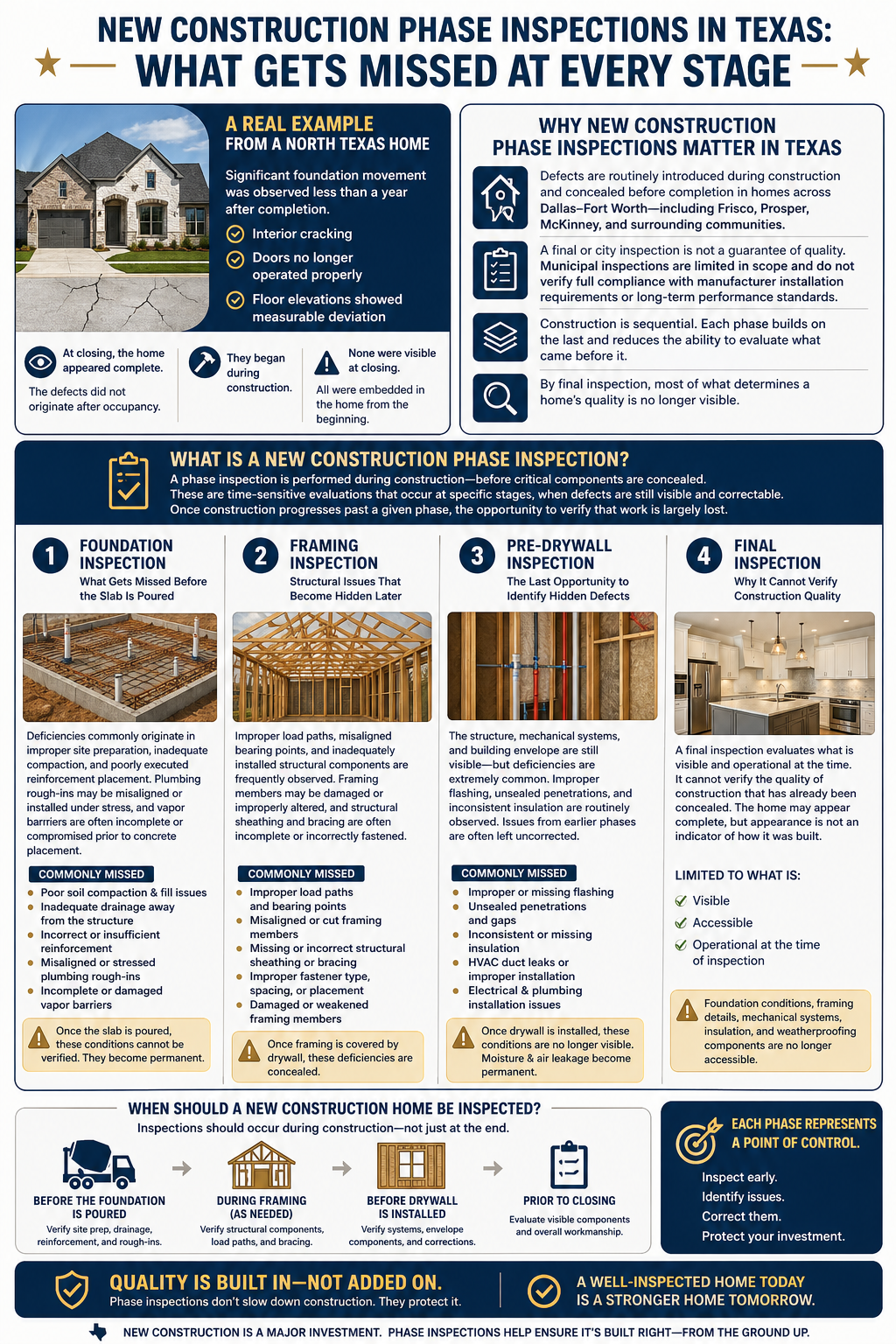
In a recently constructed home in North Texas, significant foundation movement was observed less than a year after completion. Interior cracking had developed, doors no longer operated properly, and floor elevations showed measurable deviation.
At closing, the home appeared complete. The finishes were clean, systems were operational, and no major concerns were identified during the final walkthrough.
The defects did not originate after occupancy.
They began during construction.
Site preparation had been insufficient. Drainage conditions were not properly established prior to the foundation pour. Reinforcement placement was inconsistent, and slab elevation provided minimal tolerance for water movement away from the structure.
None of these conditions were visible at closing.
All of them were embedded in the home from the beginning.
Why New Construction Phase Inspections Matter in Texas
The sheer number of deficiencies routinely missed at each stage of residential construction in Texas is staggering.
Across the Dallas–Fort Worth area—including Frisco, Prosper, McKinney, and surrounding communities—new construction homes regularly contain defects that are introduced during construction and concealed before completion.
A common assumption is that if a home passes a final inspection or a city inspection, it was built correctly. That assumption is often misplaced.
Municipal inspections, where they occur, are limited in scope. They are not comprehensive evaluations of construction quality, and they do not verify full compliance with manufacturer installation requirements or long-term performance standards.
Residential construction is sequential. Each phase builds on the last, and each phase reduces the ability to evaluate what came before it.
By the time a home reaches final inspection, most of what determines its quality is no longer visible.
What Is a New Construction Phase Inspection?
A new construction phase inspection is performed during construction—before critical components are concealed.
These inspections are not redundant. They are time-sensitive evaluations that occur at specific stages, when defects are still visible and correctable.
Once construction progresses past a given phase, the opportunity to verify that work is largely lost.
Foundation Inspection: What Gets Missed Before the Slab Is Poured
The foundation stage is one of the most critical phases of construction, yet it is rarely observed by buyers.
In new construction homes across North Texas, deficiencies commonly originate in improper site preparation, inadequate compaction, and poorly executed reinforcement placement. Plumbing rough-ins may be misaligned or installed under stress, and vapor barriers are often incomplete or compromised prior to concrete placement.
These conditions are frequently missed because the work occurs quickly, often within a narrow window, and inspections—where they occur—are limited in scope. In some areas, particularly unincorporated regions, there may be no meaningful Authority Having Jurisdiction overseeing residential construction at all.
Once the slab is poured, these conditions cannot be verified.
They become permanent.
Framing Inspection: Structural Issues That Become Hidden Later
The framing stage establishes the structural integrity of the home, but it is also where deviations from plans and standards commonly occur.
Improper load paths, misaligned bearing points, and inadequately installed structural components are frequently observed in new builds throughout the Dallas–Fort Worth area. Framing members may be damaged or improperly altered, and structural sheathing and bracing are often incomplete or incorrectly fastened.
These deficiencies are rarely evaluated in detail. Once framing is covered by drywall, they are concealed.
What remains are symptoms—cracking, movement, and misalignment—that appear later, often without clear attribution.
Pre-Drywall Inspection: The Last Opportunity to Identify Hidden Defects
The pre-drywall inspection is the most important phase for evaluating the home as a complete system.
At this stage, the structure, mechanical systems, and building envelope are still visible. However, deficiencies related to water management and air control are extremely common in Texas homes.
Improper flashing, unsealed penetrations, and inconsistent insulation are routinely observed. Issues identified in earlier phases are often left uncorrected.
This phase moves quickly, particularly in production building environments across North Texas. Once drywall is installed, these conditions are no longer visible.
Moisture intrusion pathways are concealed. Air leakage becomes permanent. Opportunities for correction are significantly reduced.
Final Inspection: Why It Cannot Verify Construction Quality
The final inspection is the most common inspection performed by buyers—and the most misunderstood.
A final inspection is valuable, but it is inherently limited. It evaluates what is visible and operational at the time of inspection. It cannot verify the quality of construction that has already been concealed.
By this stage, foundation conditions, framing details, mechanical systems, insulation, and weatherproofing components are no longer accessible.
The home may appear complete, but appearance is not an indicator of how it was built.
When Should a New Construction Home Be Inspected?
Inspections should occur during construction—not just at the end.
The most effective timing includes evaluation before the foundation is poured, before drywall is installed, and again prior to closing. Depending on the project, additional inspections during framing or system installation may also be appropriate.
Each phase represents a limited window.
Once that window closes, the ability to evaluate that work is significantly reduced.
What Gets Missed Most Often in New Construction Homes?
Across Texas, the same categories of deficiencies appear repeatedly.
Foundation preparation issues, framing defects, improper flashing, air sealing failures, and mechanical system installation problems are among the most common findings.
These are not rare conditions. They are recurring issues that develop during construction and are often concealed before they can be identified.
Can Defects Be Corrected After Closing?
Some can.
Most become more difficult to address.
Once a home is complete, access to underlying systems is limited. Corrections may require removal of finishes, disruption of occupancy, and negotiation with the builder under warranty conditions.
The most effective time to identify and correct deficiencies is during construction—before they are concealed and before closing reduces leverage.
Conclusion: What This Means for Buyers in Texas
The deficiencies that matter most in residential construction are not the ones visible at the end.
They are the ones missed along the way.
Each phase of construction presents a limited opportunity to evaluate work while it is still visible, verifiable, and correctable. Once that opportunity passes, the defect remains and the cost of resolution increases.
Most buyers assume that if a home passes inspection at the end, it was built correctly.
That assumption is often incorrect.
Because by the time construction is complete, you are no longer evaluating how the home was built.
You are living with the result.
Schedule a New Construction Phase Inspection in North Texas
If your home is currently under construction, it can still be evaluated—but timing is critical.
Texas Inspector performs new construction phase inspections throughout the Dallas–Fort Worth area, including Frisco, Prosper, McKinney, Plano, and surrounding communities.
Phase inspections are designed to identify deficiencies while they are still visible—before they become permanent conditions within the home.
There was a time when people expected new homes to be square, plumb, dry, and functional, but that expectation has been quietly value-engineered out of the process.
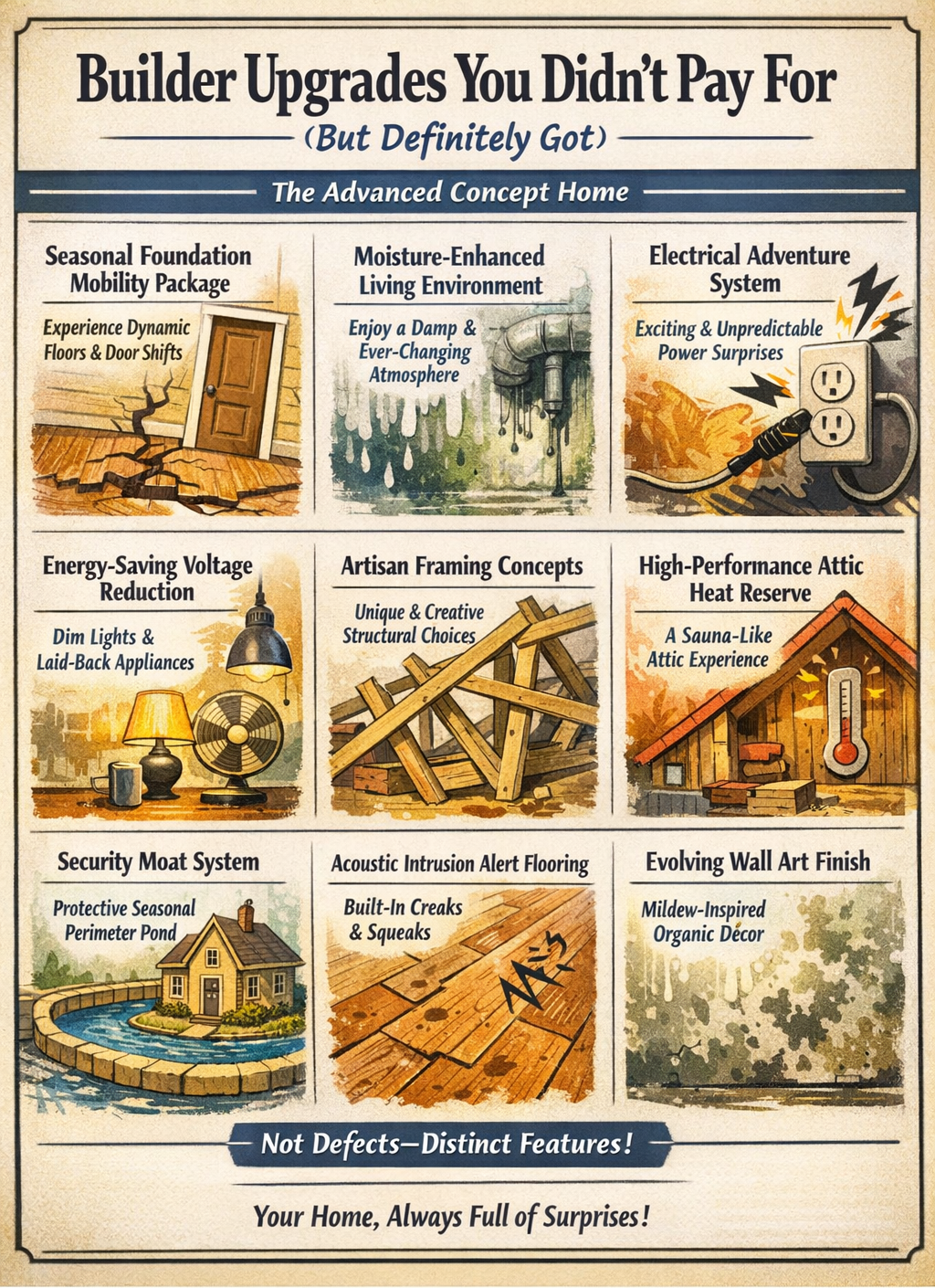
Today’s homes are delivered with a full suite of forward-thinking, builder-included enhancements designed to create a more interactive, evolving living experience, and these aren’t defects—they’re features that simply haven’t been properly marketed yet. What you received wasn’t a flawed house; it was an advanced concept home that continues to develop long after closing.
Let’s take a look at what was included.
The Seasonal Foundation Mobility Package
Why anchor your home to something as limiting as stability when North Texas soils can provide continuous, real-time movement? Doors develop personality depending on the weather, floors gently guide you in subtle directions, and cracks appear and disappear like they’re testing your attention span.
The benefit is a responsive structure that reacts to its environment, creating a home that doesn’t just sit there but actively participates in daily life.
Moisture-Enhanced Living Environment
Perfectly dry interiors are sterile and uninspired, so modern plumbing installations introduce subtle, intermittent moisture exactly where it can be appreciated. Materials soften, air develops depth, and concealed spaces begin their own quiet transformation.
The benefit is a rich indoor ecosystem that evolves over time, offering texture, atmosphere, and a sense that the home is actively doing something behind the scenes.
The Electrical Adventure System
Predictable electrical systems remove all suspense from daily life, so today’s installations may include reversed polarity, selective grounding, and breakers that operate with a degree of independence. Consistency gives way to variability, and reliability becomes more of a suggestion.
The benefit is that every outlet and switch becomes an experience, adding just enough uncertainty to keep things interesting.
Energy-Saving Voltage Reduction Technology
Why deliver full voltage when you can thoughtfully reduce it across long runs, resistance, and optimistic conductor sizing? Lights dim slightly, appliances hesitate, and motors develop a strong work ethic.
The benefit is passive energy conservation through reduced performance, allowing the home to present itself as efficient while quietly lowering expectations.
Artisan Framing Concepts
Rigid adherence to engineered plans limits creativity, so framing today embraces interpretive load paths, selective fastener use, and notching that challenges conventional limits. The result reflects field decisions more than design intent.
The benefit is a one-of-a-kind structural system that expresses individuality, where the house develops its own ideas about how it wants to behave.
High-Performance Attic Heat Containment
Why vent heat out when you can preserve it, especially in a Texas climate that already provides a strong baseline? Attics now function as thermal reservoirs, retaining heat with impressive consistency while your HVAC system rises to the occasion.
The benefit is a fully immersive climate experience that extends throughout the home, ensuring the outdoors is never completely left behind.
Secondary Roof System (Spray Foam Edition)
Why rely on a single roofing system when you can install a backup directly underneath? Spray foam applied to the underside of roof decking creates a fully adhered secondary barrier that captures any water that makes it past the primary roof.
The benefit is redundancy, allowing moisture to be retained and appreciated within the assembly rather than escaping prematurely.
Perimeter Water Retention and Security Moat System
Traditional drainage moves water away from the home, but a more progressive approach allows it to collect around the foundation, forming a seasonal perimeter moat. Flat or negative grading ensures water remains engaged with the structure after even modest rainfall.
The benefit is added security through inconvenience, as access to the home becomes a more deliberate effort, while the standing water creates ideal conditions for mosquito activity that offers repeated exposure opportunities for residents.
Exterior Wall Moisture Access
Weather barriers can be restrictive, so modern installations often allow water to bypass these limitations and interact directly with framing and sheathing. Separation between interior and exterior becomes more of a guideline than a rule.
The benefit is an open system where the home remains connected to its environment rather than isolated from it.
Fastener Efficiency Initiative
Excess fasteners create rigidity, and rigidity limits expression, so reducing nails, screws, and anchors allows assemblies to move and adapt over time. Components are no longer forced into compliance but are free to respond to conditions.
The benefit is a structure that remains flexible, both physically and philosophically, with parts that evolve instead of remaining fixed.
Acoustic Intrusion Alert Flooring System
Silent floors offer no feedback and no protection, so strategic fastener spacing and optimistic subfloor installation ensure that every step produces a distinct creak or pop. Movement becomes fully audible and impossible to ignore.
The benefit is a built-in security system that guarantees no one moves unnoticed, including the homeowner.
Interactive Wall Art Growth System (Flat Paint Upgrade)
Traditional finishes remain static, but flat paint in kitchens and bathrooms provides an ideal surface for moisture retention and gradual visual development. With time and humidity, walls begin to display organic patterns and tonal variation.
The benefit is a living art installation that evolves daily, creating a home that decorates itself without input.
Fit-and-Finish Variability Package
Perfect alignment is predictable, so cabinets drift, tile lines explore, and trim gaps invite interpretation. Precision is replaced with variation, and uniformity gives way to individuality.
The benefit is a visually dynamic environment where every space offers something slightly different.
The Big Picture
This isn’t about defects; it’s about being ahead of the curve, because while much of the industry is still focused on outdated ideas like code compliance, manufacturer instructions, and systems performing as intended, forward-thinking Texas builders have moved on to something far more ambitious. They are not interested in doing things the right way when they can do things the next way, and they are certainly not interested in being slowed down by convention, physics, or oversight.
Stable foundations, dry interiors, and predictable systems represent yesterday’s thinking, while today’s homes shift, leak, creak, dim, and grow things in real time, creating a fully interactive ownership experience. What some might call defects are better understood as innovation without the drag of quality control, where the research and development phase begins after closing, and the homeowner becomes part of the process, whether they intended to or not.
Some industries test prototypes in controlled environments, but here they are built at scale, sold with confidence, and occupied immediately, which is about as forward-thinking as it gets.
Closing Thought
If you prefer your home to remain stationary, dry, and functioning as designed, there is still an option available, although it is becoming increasingly unfashionable.
A thorough, independent inspection—performed at several phases during construction, once before closing and again before the warranty expires—remains the only reliable way to separate marketing from reality, assumptions from conditions, and features from actual defects.
Because eventually, the joke wears off, and what’s left is the substandard house.
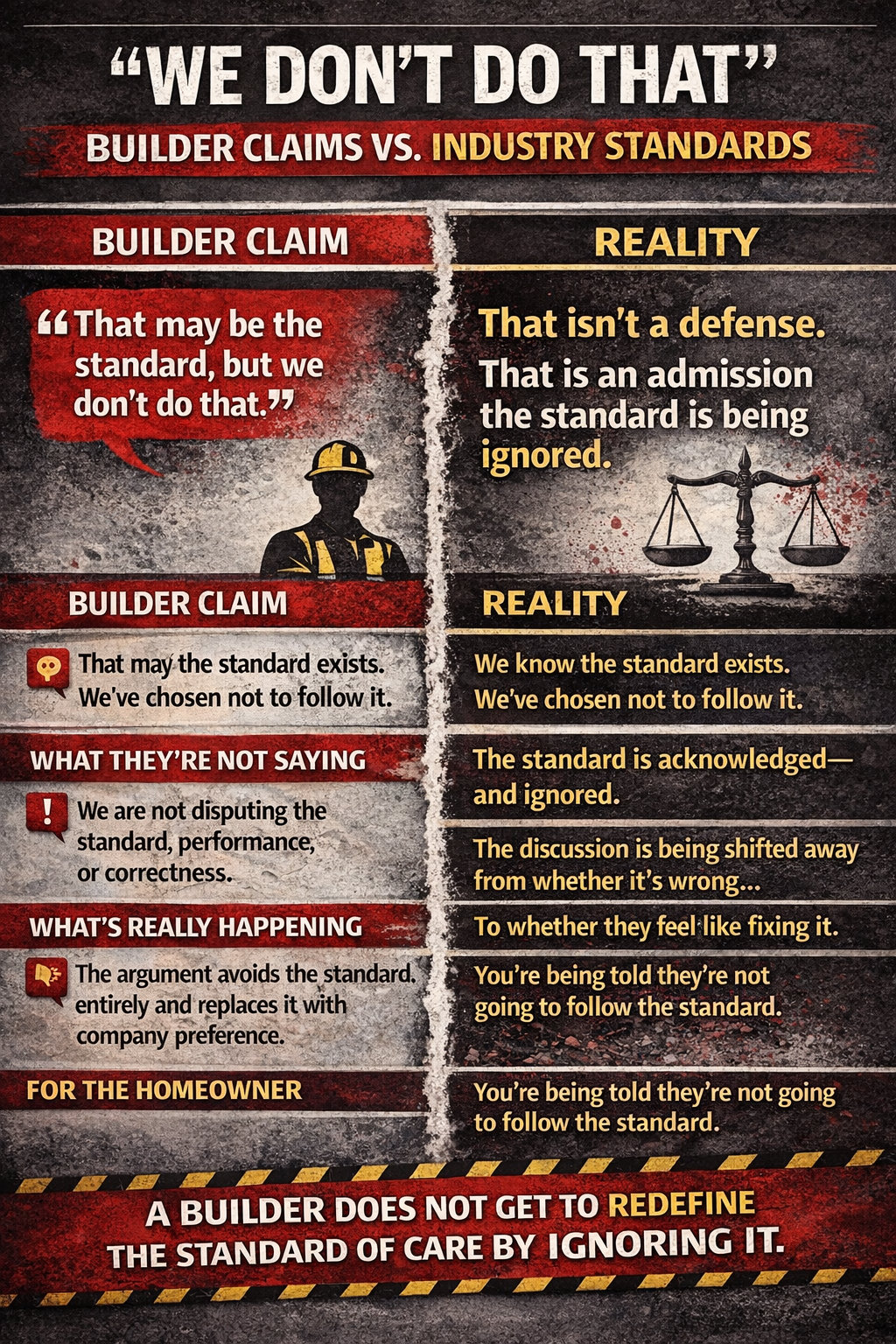
Yesterday, I received a call from a representative of a large national homebuilder regarding a report I prepared for one of my clients. The purpose of the call was not to identify an error in my report, not to point me to a conflicting manufacturer requirement, and not to offer any technical basis for why the reported conditions were acceptable. Instead, I was asked to explain to my client that, while the issues identified in my report may reflect industry standards, those standards were simply “not things they do.”
That is an extraordinary position, though probably not in the way they intended. It is one thing to argue that a condition complies with accepted practice. It is another to argue that the accepted practice exists but the builder has chosen not to follow it. That is not a rebuttal. It is not a defense. It is not even a particularly polished excuse. It is simply a corporate way of saying, “Yes, we know better, but this is how we do it anyway.”
There seems to be a growing belief in some corners of large-scale residential construction that size itself is a substitute for quality, and repetition is a substitute for correctness. Build enough houses, repeat the same details often enough, and eventually someone in the organization begins to mistake company habit for industry legitimacy. It does not work that way. An internal practice manual does not overrule accepted trade standards. A production shortcut does not become proper merely because it has been institutionalized. And a national footprint does not confer the authority to rewrite the rules of competent construction.
Industry standards are not random suggestions gathered from thin air. They come from established trade practice, manufacturer installation instructions, performance-based requirements, and, where applicable, building codes. They exist because buildings are supposed to shed water, resist movement, accommodate materials, and perform over time. These standards were not created to inconvenience builders. They were created because ignoring them predictably produces failure, damage, callbacks, and disputes of exactly the sort builders claim to be surprised by later.
What made the call especially revealing was the apparent assumption that I should help sell this explanation to my client, as though my role were to translate substandard work into more consumer-friendly language. That is not my job. I do not evaluate houses against the internal preferences of whichever builder happened to construct them. I evaluate conditions against recognized standards of care. If a builder’s answer to a deficiency is that they do not follow the standard, that does not diminish the report. It strengthens it.
Homeowners should pay very close attention whenever they hear a response like this, because “we don’t do that” is not a technical conclusion. It does not mean the condition is proper, durable, or likely to perform as intended. It does not mean the standard is debatable. It means the builder is effectively admitting that its own practices fall below what is commonly recognized as appropriate. That may be a candid answer, but it is hardly a reassuring one.
There is also something almost refreshing about the bluntness of it. Usually these conversations are wrapped in layers of polished language about variances, preferences, tolerances, and company protocols. This one, stripped to its essence, amounted to something much simpler: yes, there may be a recognized way to do it, but this builder has decided that recognized ways are for other people. That kind of honesty may be rare, but it is not the same thing as credibility.
The larger problem is that statements like this expose a mindset, not just a construction issue. When a builder treats accepted standards as optional whenever they conflict with speed, cost, or routine, the defect is no longer limited to a flashing detail, installation method, or workmanship oversight. The defect is in the culture. A company that responds to legitimate deficiencies by saying, in effect, “those standards are not part of our business model,” is saying far more than it probably should.
In the end, construction is judged by performance, not branding, market share, or self-created exemptions. A builder does not get its own private engineering reality just because it is large, well-known, or accustomed to getting away with bad answers. If the best response to an industry-standard defect is “we don’t do that,” then the report is not the problem. The work is. And if that truly is the company position, then at least the homeowner has been given one useful piece of information: the builder is willing to say out loud that its own practices are lower than the standard everyone else is expected to meet.
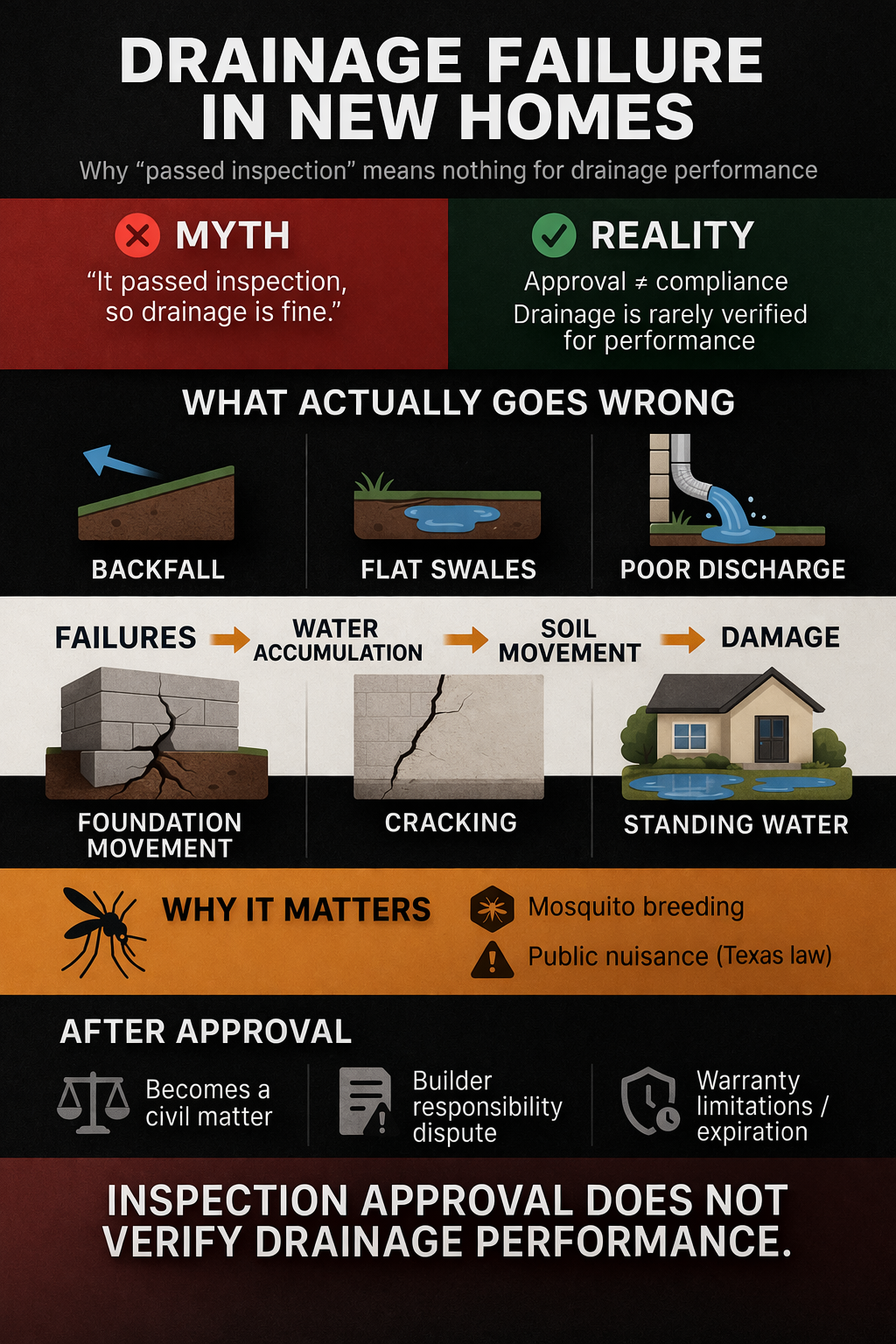
There is a persistent belief among homeowners that if a property “passed drainage,” then the lot was properly designed and constructed to move water away from the house. That belief is wrong.
What most people do not understand is that a municipal approval or final inspection does not establish that the lot actually met the minimum standard required by the code. In many cases, it only means the inspection was limited, hurried, perfunctory, or failed to identify what was plainly there. That distinction matters because a lot can receive a signoff and still have inadequate slope, ineffective swales, poor discharge locations, and drainage conditions that direct water toward the foundation rather than away from it. When that happens, the issue is not that the code allowed the failure. The issue is that the failure was missed, ignored, or passed over during the inspection process.
When a lot is graded and approved, many homeowners assume that means the drainage was proper. It does not. In many cases, it means the deficiency was not identified, not challenged, or simply tolerated in the field. That is selective code enforcement. The code establishes a minimum drainage standard, but that standard is not always meaningfully enforced. Instead, approval is sometimes based on a quick visual pass that allows noncompliant conditions to move forward as though they were acceptable.
What makes the problem worse is what happens after final approval. Once the municipality has signed off on the lot, it will typically refuse to revisit the drainage issue in any meaningful way. Homeowners who complain about standing water, negative drainage, or water collecting near the foundation are often told the same thing: the project has already been approved, the city is not going to intervene, and the matter is now a civil dispute. At that point, the homeowner is effectively pushed out of the code-enforcement process and told to contact an attorney. In other words, the municipality may fail to enforce the minimum standard on the front end, then decline responsibility on the back end after the damage becomes apparent.
In many North Texas subdivisions, lots are graded as flat as possible. This is done to maximize usable yard space, simplify construction, and increase density. Flat lots also make it easier to sell the appearance of a clean, level yard. However, flat grading combined with expansive clay soils creates a condition where drainage performance is highly sensitive to even minor deviations.
Minimal slope is often relied upon to carry water away from the structure. In practice, that slope may be marginal from the outset. Once you introduce settlement, irrigation, landscaping, and normal use, the original grading intent is easily compromised. What may have been barely adequate on the day of inspection becomes inadequate shortly thereafter.
The consequences go well beyond a soggy yard. Poor drainage directly affects foundation performance because it creates inconsistent soil moisture conditions around the structure. In expansive clay soils, that matters. When soils adjacent to the foundation become excessively wet while other areas remain comparatively dry, the result is differential movement. One portion of the foundation may heave while another settles or remain relatively stable. That uneven support is what translates into cracking, distortion, and long-term structural distress. Poor drainage is therefore not merely a site nuisance. It is often a contributing cause of foundation-related damage.
Poor drainage also creates site conditions that promote mosquito breeding. Water that ponds in swales, low areas, splash zones, and poorly drained side yards does not just sit there harmlessly. It becomes habitat. Under Texas law, mosquito-breeding water is treated as a public health nuisance within municipalities, and breeding areas for disease-transmitting mosquitoes may qualify as a nuisance regardless of location. Municipalities have express authority to require stagnant water to be drained or regulated, and counties may act against unsanitary conditions in unincorporated areas that are likely to attract or harbor mosquitoes. In practice, that means these drainage failures are not just performance issues. They can also create conditions that violate public health standards.
Three recurring failure patterns show up consistently in these conditions. The first is backfall toward the foundation. Soil movement and disturbance frequently result in negative drainage, where water moves toward the structure instead of away from it. This is not an unusual or isolated condition. It is routinely observed in relatively new construction, and it contributes directly to elevated moisture levels at the foundation perimeter.
The second is the presence of swales that do not actually function as drainage paths. Swales are often too shallow or too flat to convey water effectively. They may also be interrupted by fences, landscaping, or adjacent grading that was not coordinated properly. Instead of directing water away, they allow it to collect and infiltrate near the foundation or remain ponded long enough to become a breeding ground for mosquitoes.
The third is improper discharge from downspouts. Even where gutters and extensions are installed, the discharge point is frequently located in an area that lacks sufficient slope to carry the water away. In some cases, the water is simply redistributed around the foundation rather than removed from the vicinity of the structure. That repeated wetting of the soils near the house further undermines foundation performance and worsens already marginal drainage conditions.
Municipal inspections are not designed to function as detailed performance evaluations. They are limited in time and scope and are typically conducted under production pressures. Inspectors are not returning after settlement occurs, and they are not evaluating how the lot performs during actual rainfall events. They are observing conditions at a moment in time and making a determination based on what is readily visible.
This creates a disconnect between approval and performance. A lot can be signed off and still fail to meet the minimum drainage requirements of the code. When that happens, the issue is not theoretical. It shows up in the form of standing water, mosquito activity, water accumulation near the foundation, inconsistent soil moisture, and eventual structural movement.
When homeowners push back, builders often respond with theater rather than substance. One common tactic is to trot out the project surveyor to “bless” the grading and drainage, as though the surveyor’s opinion resolves the issue. It does not. A surveyor may locate elevations or depict site features, but that does not give the surveyor authority to determine whether the lot complies with the code’s drainage requirements or whether the observed performance is acceptable. Another tactic is to recite some invented rule, such as the claim that standing water is not a problem unless it remains for 48 hours or more. That kind of statement gets repeated as though it were a legal standard, when in many cases it is nothing more than a convenient piece of builder folklore (read: bullshit) used to deflect complaints. Neither the surveyor’s blessing nor the builder’s made-up timeline changes the actual question, which is whether the lot drains away from the structure as required.
These problems rarely present as immediate failures. Instead, they develop gradually. Water collects near the foundation, soils expand and contract unevenly, and the structure begins to respond. Interior symptoms such as cracking, door misalignment, and floor irregularities are often the first indicators noticed by the homeowner. Outside, the owner may also notice persistent ponding, muddy side yards, water that remains long after a rain event, and increased mosquito activity in the affected areas.
By the time those symptoms appear, the drainage condition has typically been present for an extended period. The original cause is no longer obvious, and attention is often directed toward cosmetic repairs rather than the underlying issue. Just as important, by the time drainage-related foundation damage becomes sufficiently pronounced to force the issue, the builder is often already beyond the warranty period. Even where warranty coverage technically remains, whether the condition is covered may depend on the severity of the damage and the builder’s warranty language. In practice, that means the homeowner may not discover the true nature of the problem until the builder is out from under the warranty altogether, or until the claim is substantial enough to trigger a coverage fight.
From a defect and litigation standpoint, drainage failures are frequently disputed. Builders often rely on the fact that the lot was approved at final inspection. Municipalities, having already signed off, commonly take the position that the matter is no longer an enforcement issue and instead belongs in the realm of private dispute. The homeowner is then left in the worst possible position: the city treats the approval as final, the builder treats the approval as proof of compliance, and the homeowner is told to hire counsel and fight it out as a civil matter. However, approval does not establish compliance. It only establishes that the condition was not rejected at the time. If the lot does not drain in accordance with the code, then it does not comply, regardless of what the inspection record shows.
Early documentation becomes critical in these cases. If the condition is identified and recorded before significant homeowner modification, it is much easier to demonstrate that the deficiency originated with the original grading and construction. Once landscaping changes, irrigation patterns, and other alterations occur, the argument becomes more complicated.
The underlying issue is not that the code permits these drainage failures. The code requires that drainage direct water away from the structure. The problem is that deficient work is often allowed to proceed through superficial inspection processes and later defended with the claim that approval equals compliance. Once the municipality has washed its hands of the issue and recast it as a private civil dispute, the burden shifts almost entirely to the homeowner to prove what should have been addressed at the outset.
Modern residential drainage systems are not failing unpredictably. In many, if not all, cases, they are never functioning properly to begin with. The failure is simply delayed long enough that it is no longer associated with the original construction, even though the damage, nuisance conditions, and consequences were built into the lot from the start.
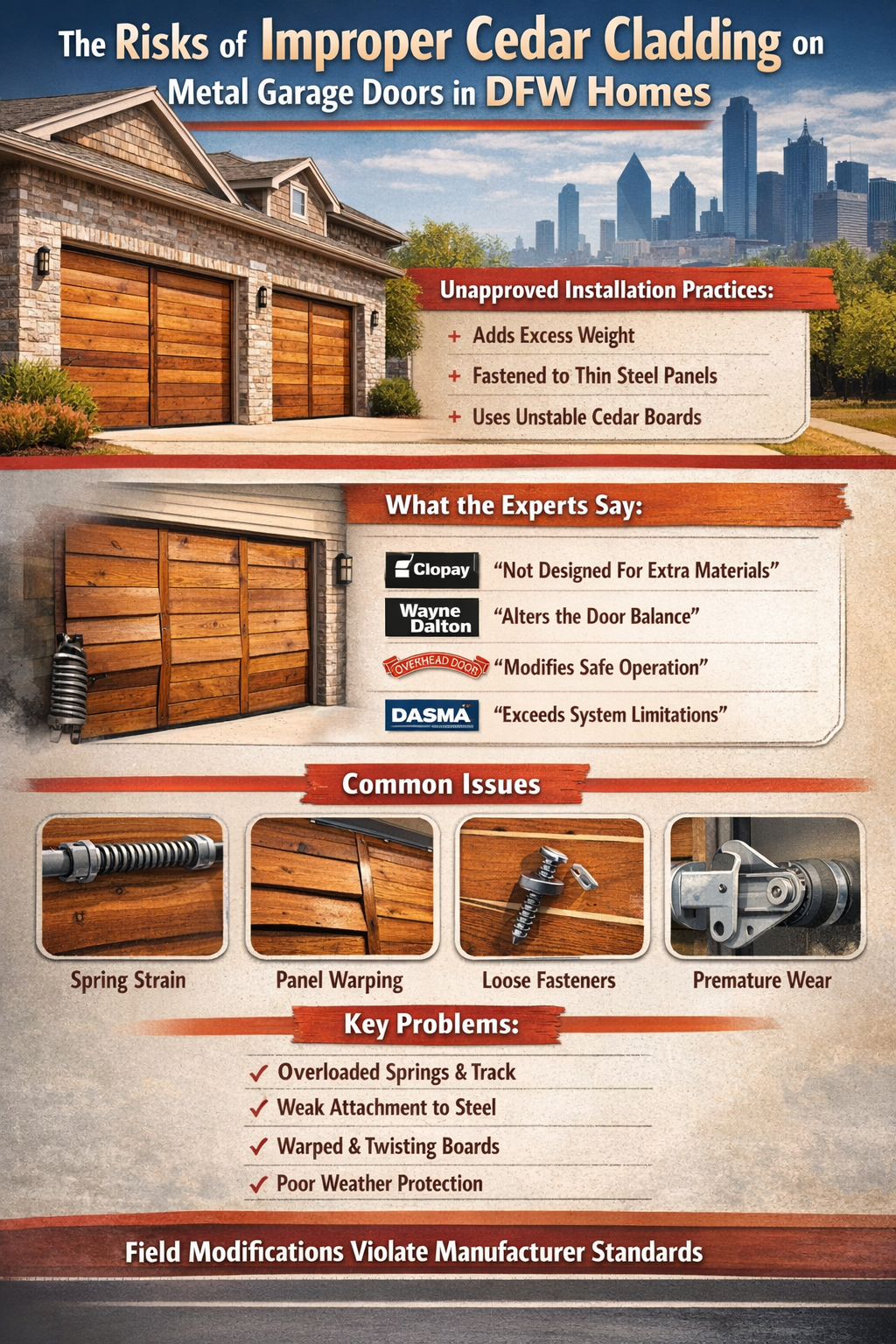
Throughout the Dallas–Fort Worth area, many newer homes feature garage doors that appear to be solid cedar carriage-style doors. The look is attractive and has become extremely popular with production builders attempting to create a more upscale architectural appearance. What many homeowners do not realize, however, is that most of these doors are not actually wood doors at all. In many cases they are standard steel sectional garage doors that have had No. 2 grade western red cedar planks attached directly to the exterior face of the metal door panels. While the appearance may be appealing when new, this method of construction frequently creates a number of predictable long-term problems.
Residential garage doors manufactured by companies such as Clopay, Wayne-Dalton, Amarr, and Overhead Door Corporation are engineered mechanical systems. A sectional garage door consists of lightweight steel panels connected by hinges and supported by rollers that travel within tracks. The door itself is counterbalanced by torsion or extension springs that are carefully calibrated for the exact weight of the door as it leaves the factory. When properly balanced, a garage door can be lifted manually with very little effort because the spring system offsets nearly all of the door’s weight. The springs, hardware, and door panels are designed to function as a single engineered system in which the weight of the door plays a critical role.
In many production homes, however, builders take a standard steel door and attach cedar boards to the face of the door panels in order to simulate the appearance of a traditional carriage house door. This modification may seem cosmetic, but it fundamentally alters the engineered system. Garage door industry guidance published by the Door & Access Systems Manufacturers Association (DASMA) makes clear that garage door assemblies must operate within the structural and mechanical limitations of the system as designed. Door weight, spring capacity, hardware strength, and panel construction are all interconnected components. When cedar boards are added after installation, the weight of the door increases, and the balance that the spring system was designed to maintain can be compromised.
When the weight of the door changes without corresponding adjustments to the spring system, the door can become improperly balanced. An out-of-balance door places additional stress on hinges, rollers, tracks, and the garage door opener. Over time this additional stress can lead to premature wear, noisy operation, or shortened service life of the mechanical components. In some cases the added weight also contributes to door misalignment or operational issues that homeowners may not immediately recognize as being related to the cedar overlay.
Another common problem involves the method used to attach the cedar boards. Many residential steel doors are constructed with relatively thin sheet-steel skins supported by internal reinforcement stiles. When installers place wood screws randomly through the exterior face of the panel, those fasteners frequently penetrate only the thin steel skin rather than the structural members of the door. This type of attachment provides limited holding strength. As the wood expands and contracts due to seasonal moisture changes, the fasteners can loosen, allowing boards or trim pieces to shift, warp, or pull away from the door surface.
The wood material itself also contributes to the problem. The cedar used in these installations is typically No. 2 grade western red cedar siding. Although cedar can perform well as an exterior cladding when properly installed, No. 2 grade material contains knots and irregular grain patterns that make it less dimensionally stable than higher-grade finish lumber. Under the intense sunlight and temperature fluctuations common in North Texas, cedar boards frequently cup, twist, shrink, and develop surface checking. When those boards are rigidly attached across sectional door panels that must articulate as the door moves through the curved track system, the natural movement of the wood can distort the door panels or loosen the fasteners holding the boards in place.
Improper finishing of the cedar further accelerates deterioration. In many new homes the boards are installed before being sealed on all sides, and staining may be delayed for weeks or months after installation. Cedar that is exposed to sun and rain without adequate protection quickly dries out and begins to weather. The resulting cupping, cracking, and uneven color are often not the result of defective materials but rather the predictable outcome of using construction-grade wood in a location where it experiences continuous exposure to the elements.
It is important to note that wood-appearance garage doors can be manufactured correctly. Many door manufacturers offer products designed specifically to carry wood overlays or to replicate the appearance of wood doors. These doors are engineered differently from standard steel doors and typically include reinforced internal framing, heavier-gauge steel components, additional structural bracing, and spring systems designed to support the additional weight of the wood. Simply attaching cedar planks to a standard steel sectional door bypasses these engineered design features.
The widespread use of cedar-clad garage doors by production builders often leads homeowners to assume the installation is normal and fully compatible with the door system. In reality, the practice is largely an aesthetic modification performed after the door has been manufactured and installed. Over time the combination of increased door weight, inadequate fastener attachment, natural wood movement, and exposure to weather frequently results in warped boards, loose trim, operational issues, and increased maintenance requirements.
For homeowners evaluating these installations, the issue is not simply whether the door looks attractive on the day the house is delivered. The more important question is whether the door system was designed and installed in a way that respects the engineering limitations of the garage door assembly. When cedar planks are attached to standard steel doors without proper structural design and finishing practices, the result is often a cosmetic upgrade that creates long-term mechanical and maintenance problems.

Drive far enough past civilization and something extraordinary happens.
Language detaches from reality.
Geology becomes optional.
Shame evaporates.
You’ll know you’ve crossed into the Exurban Fantasy District when you see:
“Les Château Montclair Highlands at La Cima Lake Preserve.”
Les.
Château.
Mont.
La.
Cima.
Lake.
Preserve.
You are standing on what was cotton or sorghum last year.
The only French thing within ten miles is the font on the monument sign.
The Frenchification of Former Agriculture
At some point, someone decided “Cedar Ridge” wasn’t delusional enough.
So now the cotton fields are reborn as:
- Les Jardins
- Montclair
- Belle Pointe
- Château Ridge
- Versailles Creek
- Val d’Or Estates
- La Cima Highlands
- Montpellier Preserve
Mont means mountain.
There is no mountain.
Cima means summit.
The only summit is the top of the limestone sign.
Château implies stone walls and vineyards.
You have vinyl windows and a lawn that was installed on Tuesday.
Versailles implies palace grounds.
You have a stormwater pond and a mosquito management contract.
But pronounce it with confidence and suddenly everyone pretends we’re in Provence instead of on former sorghum.
The Five-Gallon Lake Standard™
If a development contains a body of water larger than a five-gallon Home Depot bucket, it automatically qualifies as:
Lake.
Doesn’t matter if:
- It was dug six months ago.
- It has a concrete overflow pipe.
- It exists strictly to manage runoff.
- It smells faintly of fertilizer and drainage.
If two ducks land in it, congratulations:
Lac Montclair Estates.
You are not lakefront.
You are detention-adjacent.
But detention-adjacent doesn’t move inventory.
Lake does.
Preserve: Translation — “We Couldn’t Build There”
“Preserve” is not ecological reverence.
It’s surrender.
Preserve means:
“The geotech report said absolutely not.”
It’s the back corner of the plat where water collects and resale photos avoid.
But add French:
Les Jardins Preserve.
Now it sounds curated.
It’s not curated.
It’s hydrological compromise.
Highlands on Flatland
We are on Blackland Prairie.
If your subdivision uses:
- Highlands
- Summit
- Crest
- Bluff
- Ridge
You are participating in geological fiction.
The highest elevation change in most of these developments is the curb reveal.
But developers slap “Highlands” on the sign like they’re carving chalets into Alpine slopes.
You are not in the Alps.
You are on clay that expands when it rains and contracts when it doesn’t.
Estates: Aristocracy on Quarter-Acre Lots
Estate implies land.
You have 0.19 acres.
Estate implies distance.
You can hear your neighbor microwave popcorn.
Estate implies lineage.
You have an HOA violation notice about trash cans.
“Manor” suggests generational wealth.
You have a 30-year mortgage and a mailbox compliance committee.
“Sovereign” implies dominion.
You are governed by architectural review.
The Monument Sign Is the Real Investment
The monument sign is the most structurally ambitious thing in the subdivision.
- Carved limestone
- Imported script
- Accent lighting
- Faux wrought iron scrollwork
- Possibly a decorative fountain attempting Versailles
The sign has more permanence than the soil beneath the slabs.
The sign whispers legacy.
The subgrade whispers movement.
The Naming Meeting
Imagine the conference table.
“We need something more European.”
“Add Mont.”
“There’s no mountain.”
“Doesn’t matter.”
“Add Lake.”
“It’s a retention basin.”
“Call it Lake.”
“Add Preserve.”
“We couldn’t build there.”
“Perfect.”
And thus:
Les Montclair Sovereign Lake Highlands Preserve Estates.
It sounds hereditary.
It’s Phase III on former cotton.
The Truth They Can’t Market
If honesty prevailed, developments would be named:
- Former Cotton Parcel Section B
- Retention Basin Adjacent Estates
- The Enclave at Expansive Clay
- Sorghum Ridge Slight Grade Change
- Puddle du Nord
Hard to move half-million-dollar homes in Puddle du Nord.
So instead, you get a limestone lie with a French accent.
Final Reality Check
There are no mountains.
There are no sovereign ridges.
There are no estates.
There are no lakes beyond the five-gallon threshold.
There is clay.
There is wind.
There is former cotton and sorghum under your foundation.
And there is a monument sign working overtime to convince you that this cul-de-sac is a duchy.
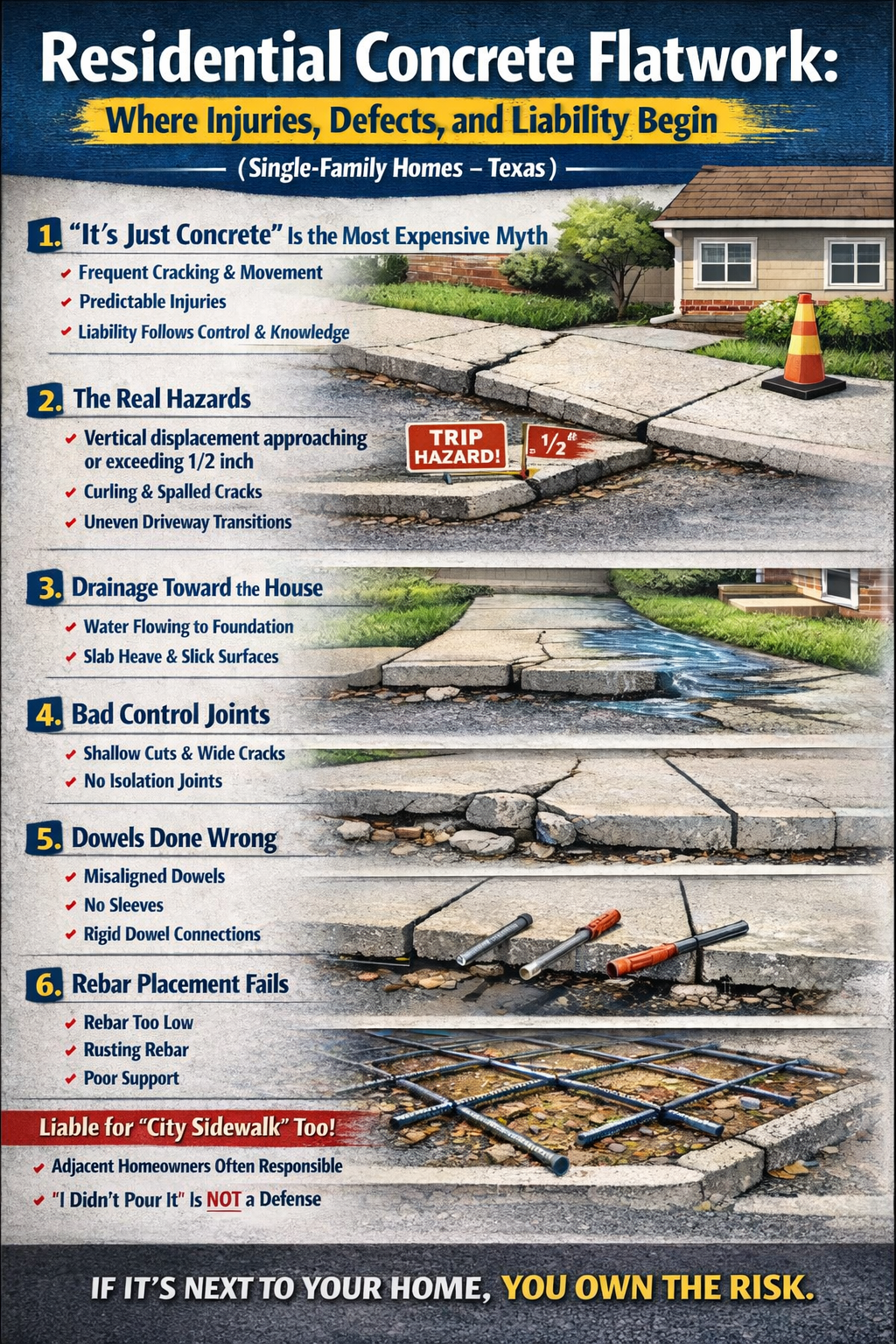
At residential houses, concrete flatwork—driveways, sidewalks, patios, walkways, steps, and approach slabs—is routinely dismissed as simple, low-risk construction. That belief is wrong. In Texas, defective residential flatwork is a predictable source of personal injury, drainage failures, slab movement, insurance disputes, and homeowner liability.
This discussion applies only to residential properties. No commercial sites. No industrial slabs.
What Counts as Residential Flatwork
- Driveways and driveway extensions
- Sidewalks and private walkways
- Patios and exterior slabs
- Steps, landings, and porch slabs
- Service walks and similar site concrete
Flatwork is not a foundation, but it is still regulated by residential building codes, drainage requirements, and Texas premises-liability law. When it fails, liability almost always follows control and maintenance, not who originally poured it.
The Primary Residential Flatwork Failures That Create Liability
(Sections on trip hazards, drainage, joints, dowels, and rebar remain as previously written and apply equally here.)
Critical Addition: Liability Exists Even When the Sidewalk Is “City-Owned”
One of the most dangerous misconceptions homeowners have is this:
“That’s the city sidewalk — not my problem.”
In Texas, that assumption is often legally wrong.
Ownership vs. Responsibility (They Are Not the Same)
While many residential sidewalks are located within the public right-of-way, abutting property owners are frequently responsible for maintenance and hazard correction, either by ordinance, common law, or both.
Key legal realities:
- Cities commonly place maintenance responsibility on the adjacent homeowner
- Homeowners may be required to repair, replace, or remove hazards
- Failure to do so can expose the homeowner to shared or primary liability
A sidewalk does not have to be privately owned for a homeowner to be legally exposed.
How Homeowners Get Pulled Into Sidewalk Injury Claims
Homeowners are routinely named in lawsuits involving sidewalk injuries when:
- The hazard is adjacent to their property
- The condition is long-standing or visible
- Tree roots, drainage, or settlement from the lot contributed
- The homeowner knew or should have known of the condition
Vertical displacement, spalling, cracking, or ponding water adjacent to a residence can establish constructive notice—even if the city technically owns the concrete.
Typical Residential Sidewalk Defects That Trigger Liability
- Vertical offsets from settlement or heave
- Cracked panels with spalled edges
- Tree-root uplift originating from the yard
- Driveway-sidewalk interface displacement
- Water flowing across sidewalks and freezing or algae growth
Once a condition is visible and persistent, the argument that the homeowner had “no responsibility” becomes weak—especially if the defect is tied to site drainage, landscaping, or flatwork modifications on the lot.
“The City Should Have Fixed It” Is Not a Defense
In premises-liability litigation, courts do not stop at ownership. They examine:
- Who controlled the adjacent property
- Who benefited from the sidewalk
- Who knew or should have known
- Who failed to act
A city’s failure to repair does not automatically absolve the homeowner. In many cases, liability is shared, and the homeowner becomes the easier target.
Insurance Reality for Sidewalk Claims
Homeowners insurance may:
- Deny coverage if the condition was known
- Reduce payouts due to long-term neglect
- Subrogate against the homeowner after settlement
Once cracking, displacement, or tree-root uplift is obvious, insurers expect action—regardless of whose name is on the right-of-way map.
Why Flatwork Defects Escalate Faster at Sidewalks
Sidewalks experience:
- Constant pedestrian traffic
- Guests, delivery drivers, postal carriers, children
- Visibility from the street (easy plaintiff photos)
Combine that with:
- Improper dowels
- Misplaced rebar
- Poor jointing
- Drainage from the lot
…and a “minor” sidewalk defect becomes a high-exposure injury condition.
Bottom Line (Residential Only)

A recent Houston Chronicle report described a Texas military veteran who protested outside the headquarters of David Weekley Homes, alleging serious defects in his newly constructed home and unresolved warranty issues.
Regardless of where the ultimate facts land in that specific dispute, the larger lesson is not about one builder.
It is about risk.
When a homeowner-especially a veteran who served this country-feels compelled to stand outside a corporate office with a protest sign, something in the dispute resolution process has broken down.
New-construction buyers in Texas should pay attention.
New Home ≠ Perfect Home
There is a widespread assumption that “brand new” means:
- Fully compliant
- Properly supervised
- Carefully inspected
- Structurally sound
In reality, most production homes are built in compressed timelines using rotating subcontractor crews. High volume increases variability.
Even reputable, nationally recognized builders rely on dozens of independent trades working under scheduling pressure.
Defects are not rare. They are predictable.
Why Municipal Inspections Are Not Enough
In Texas, city inspectors enforce the locally adopted version of the International Residential Code. Their role is limited to verifying minimum code compliance at specific inspection stages.
They do not:
- Perform forensic moisture analysis
- Remove finishes
- Verify every manufacturer installation requirement
- Represent the homeowner
A green sticker from the city means the house passed a limited inspection at a moment in time.
It does not mean the home is defect-free.
The Types of Problems That Lead to Escalation
When disputes escalate to public protest, the issues are usually not cosmetic.
They often involve:
Improper flashing, drainage, or cladding details that allow moisture into wall systems.
Improper framing connections, settlement concerns, or load path deficiencies.
Improperly protected branch circuits, panelboard defects, or missing AFCI/GFCI protection.
Improper slope away from foundations leading to ponding and foundation risk.
These are not “punch list” items. They affect safety, durability, and long-term value.
Why Warranty Processes Sometimes Fail
Most production builders have structured warranty departments. When defects are reported:
- The builder inspects.
- The builder decides the scope.
- The builder chooses the repair method.
- The builder documents the resolution.
That structure is not inherently improper-but it is not independent.
If a homeowner believes the root cause is not being addressed, trust erodes quickly.
Under Texas Property Code Chapter 27 (Residential Construction Liability Act), homeowners must:
- Provide written notice of defects.
- Allow the builder to inspect.
- Allow the builder an opportunity to offer repairs.
If either side mishandles that process, conflict escalates.
Public protest is usually the last step-not the first.
What Buyers Should Do Instead of Waiting for Crisis
The lesson from this protest is not “avoid large builders.”
The lesson is “protect yourself early.”
- Inspect Before Drywall
This is the only time framing, plumbing routing, electrical runs, and structural components are visible.
- Inspect Before Closing
Do not rely on a final walkthrough alone.
- Inspect Before Warranty Expiration
Many defects manifest within the first year.
- Document Everything
Photographs. Dates. Written communication.
Technical documentation creates leverage. Emotion does not.
Systemic vs. Isolated Defects
When a dispute involves a production builder in a subdivision, two possibilities exist:
- The issue is isolated to one home.
- The issue reflects a repeated construction method across multiple homes.
If systemic, neighbors may be experiencing similar issues without knowing it.
That is when disputes gain traction-and sometimes media coverage.
The Larger Reality
The veteran in the Chronicle story felt unheard.
No homeowner-veteran or otherwise-should feel that public protest is the only avenue left.
But the reality is this:
- Construction is imperfect.
- Oversight varies.
- Documentation protects you.
- Independent inspection reduces escalation.
Your home is likely the largest investment you will ever make.
Treat it like one.
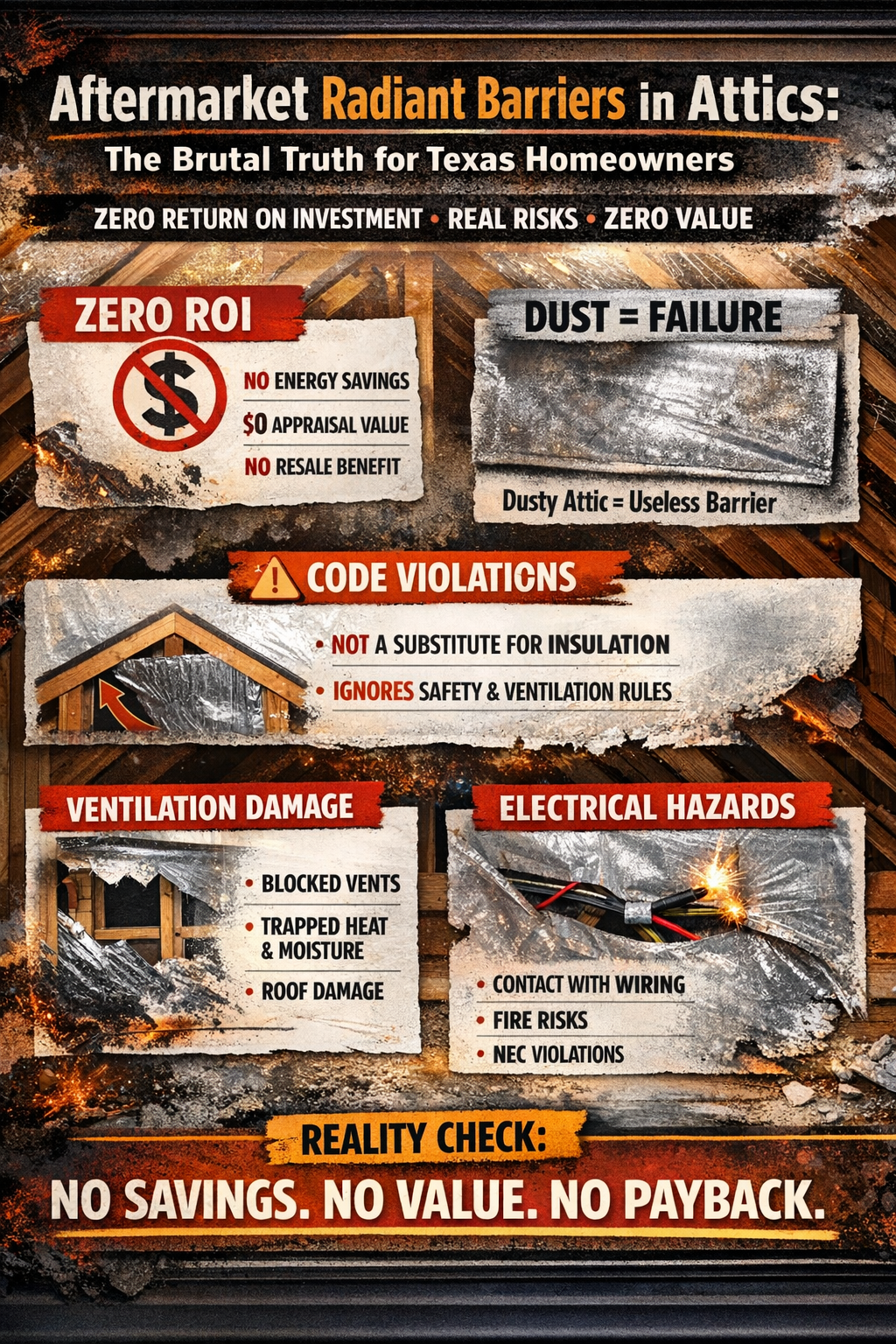
Let’s finish the job and say the quiet part out loud.
For the overwhelming majority of Texas homes, aftermarket radiant barriers installed in attics deliver effectively zero return on investment. Not “low.” Not “long-term.” Zero. And in many cases, the homeowner actually goes backward financially by introducing new defects that cost far more to correct than the barrier ever saves.
This isn’t theory. This is inspection reality.
Start With the Code (Because the Math Starts There)
Texas enforces the 2021 International Energy Conservation Code (IECC).
- IECC R402.1 & R402.2
Attic insulation R-values are mandatory (typically R-38 across most of Texas).
Radiant barriers do not reduce those requirements.
Radiant barriers do not replace insulation.
Translation:
You are paying for a product that earns you no code credit whatsoever.
No reduced insulation cost.
No compliance offset.
No performance substitution.
From a regulatory standpoint, the radiant barrier is dead weight.
ROI Requires Measurable, Durable Performance
Radiant barriers fail both tests.
- Any Energy Savings Are Marginal at Best
Even under ideal conditions, aftermarket radiant barriers may slightly reduce peak attic heat gain. That does not translate into meaningful, bankable utility savings once you factor in:
- Existing insulation (already doing the heavy lifting)
- Duct leakage and losses
- Air infiltration
- Thermostat behavior
- Seasonal variability
Tiny reductions in HVAC runtime do not justify four-figure installations.
- Performance Degrades Rapidly
Radiant barriers require:
- A clean reflective surface
- An adjacent air space
Texas attics are dusty. Period.
Once the foil loads up with dust-and it will-the reflectivity drops sharply. At that point, energy “savings” drop to statistical noise.
There is no maintenance plan.
There is no re-cleaning.
There is no performance warranty anyone actually enforces.
Your “investment” quietly dies in the dark.
Zero Appraisal Value. Zero Resale Credit.
Here’s the part no salesman will ever admit:
- Appraisers do not assign value to aftermarket radiant barriers
- Realtors do not list them as upgrades
- Buyers do not pay more for them
- Inspectors do not credit them toward performance compliance
They do not increase square footage.
They do not improve structural systems.
They do not reduce deferred maintenance.
From a resale standpoint, they are invisible-unless they caused a problem.
Negative ROI Is Common – And Inspectors See It All the Time
Aftermarket radiant barriers routinely create costs instead of savings.
Ventilation Damage
Foil blocks:
- Soffit intakes
- Ridge vents
- Gable vents
Result:
- Hotter attics
- Moisture accumulation
- Roof decking deterioration
- Shortened shingle life
Roof repairs erase decades of hypothetical energy savings.
Electrical Issues
Radiant barriers are conductive.
Improper installations:
- Contact NM wiring
- Create abrasion points
- Interfere with lighting clearances
Corrections required under the 2023 NEC are not cheap-and not optional.
Fire and Listing Concerns
Attic materials must meet flame spread and smoke development limits consistent with:
- IRC R302.10
- IRC R316 (where applicable)
Unlisted or undocumented foil products create liability exposure, not value.
The Sales Pitch vs. Reality
What homeowners are told:
- “It’ll pay for itself.”
- “You’ll see huge savings.”
- “Your attic will be dramatically cooler.”
- “This is a smart investment.”
What actually happens:
- Utility bills barely move
- Dust kills performance
- Ventilation gets compromised
- Inspection findings multiply
- Repair costs exceed savings
That’s not ROI. That’s a sunk cost with interest.
The Only Honest ROI Statement
For a typical Texas home with code-compliant insulation:
Aftermarket radiant barriers have no realistic path to payback.
They:
- Do not reduce required insulation
- Do not add appraised value
- Do not produce durable savings
- Do not improve resale
- Frequently create downstream repair costs
From a financial standpoint, they are money spent, not money invested.
The Bottom Line (No Soft Edges)
If your attic:
- Lacks insulation → fix insulation
- Leaks air → seal it
- Has bad ductwork → repair it
- Has poor ventilation → correct it
Every one of those items produces measurable, durable ROI.
Aftermarket radiant barriers do not.
In Texas, they are most often a zero-return product sold with absolute confidence, installed with casual disregard for ventilation and wiring, and defended with anecdotes instead of data.
That’s not building science.
That’s salesmanship.
Page 1 of 2012345...1020...»Last »


